Should your media assets live in the content management system (CMS) or in a separate digital asset management (DAM) system? The choice between a headless DAM and CMS-native asset management depends on how you use those assets. The platform you bought will not decide it, because major platforms support both models.
What matters is reuse: how many channels, systems, and teams draw on the same assets. We explain both models first, and the article ends with a 5-point checklist you can run against your own stack.
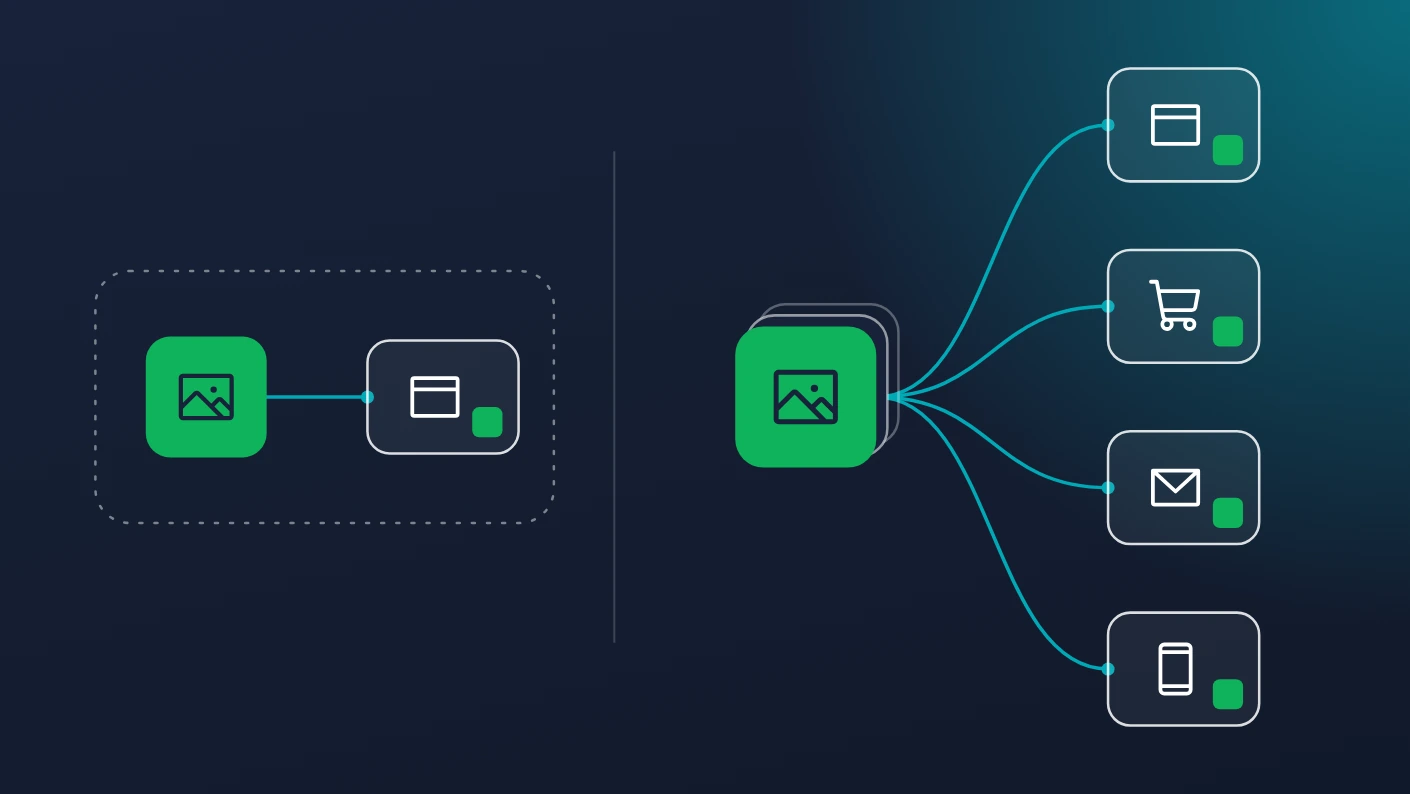
What is the difference between a headless DAM and CMS-native asset management?
A headless DAM is a standalone system that stores, transforms, and governs media assets. It exposes them to any channel through an API and does not depend on any single CMS or commerce platform. CMS-native asset management is the media library built into the CMS, and it covers only what that one system delivers.
The two do different jobs. A DAM is the system of record for rights, versions, and derivatives across every channel an asset touches. A media library manages files for the content one CMS delivers.
Do Adobe and Sitecore keep DAM separate from the CMS?
Not entirely. Both have a DAM as a separate product and connect it to their CMS.
SitecoreAI DAM, previously Content Hub, runs either standalone or as part of the SitecoreAI platform. Within the platform, DAM and CMS share one data model so that page authors can access approved assets without manual transfer.
Adobe's Experience Manager Assets is its DAM, and Experience Manager Sites is its CMS, both in the Experience Manager family.
Analysts rank these as DAM products in their own right. Gartner evaluates both Sitecore and Adobe in its Magic Quadrant for Digital Asset Management Platforms, and the 2026 edition named both Leaders.
So the choice is open on major platforms, and you still have to work out whether you need a DAM at all.
Does a headless CMS like Contentful ship its own DAM?
Contentful, a headless CMS that has been part of Salesforce since September 2026, takes the other route. It offers basic media management and leaves DAM to partners such as Bynder, Cloudinary, and Brandfolder, which plug in through its marketplace.
We implement composable stacks built on SitecoreAI, Optimizely, Contentful, and other platforms. A common pattern is for the CMS to handle structured content, the DAM to handle media, and an API to connect the two. Whether you need that DAM layer depends on the checklist at the end of this article.
What does headless change about asset management?
A headless CMS separates the back end from the presentation layer. It stores and manages content, and any front end requests that content through an API. Headless is a delivery model, and suite platforms support it too.
For assets, this means the same file and its metadata reach a product page, a blog post, an email platform, and a paid social feed without four separate uploads. A CMS-native library reaches only the channels that one CMS delivers to. To use an asset elsewhere, someone has to export it and reupload it, losing the metadata trail.
A lesson from Brimit's experience
The same manual loop appears wherever a channel does not connect to the asset source. Picturepark, a Swiss DAM vendor, saw this with its customers. Many of them shared news, product catalogs, and marketing materials through SharePoint, and their teams had to search for an asset in Picturepark, download it, and upload it to SharePoint.
We built a connector that brings the Picturepark library into SharePoint. Folders stay in sync with the DAM and files arrive with their metadata. Content managers need no Picturepark account and do not have to know the platform.
When is a CMS-native library enough?
In Forrester Consulting research commissioned by Orange Logic, 80% of organizations surveyed said they plan to increase DAM investment over the next two years. Even so, not every brand needs a standalone DAM.
A single-market site with one CMS, a small catalog, and no meaningful cross-channel reuse can run perfectly well on a built-in media library. The decision is about how many channels pull the same asset, and how many people outside the CMS need to find it.
Do you need a standalone DAM? A 5-point checklist
A standalone DAM is worth it if two or more of these are true:
- Assets are reused across more than two channels, such as site, commerce, email, paid social, and partner feeds
- More than one CMS, commerce platform, or regional site draws on the same library
- Rights, usage windows, or regional restrictions need to be enforced in one place instead of channel by channel
- Non-technical teams, such as agencies and regional marketers, need self-serve access without CMS logins
- Asset volume or file sizes have outgrown what the CMS media library was built to handle
If fewer than two apply, the built-in library is likely enough for now. If two or more apply, the next question is which DAM fits your stack: the one on your CMS vendor's platform or an independent one.
Not sure where you land? Talk to our team about your content stack.
FAQ
What does headless mean for a DAM specifically?
A headless DAM delivers assets, metadata, and renditions through an API. It does not limit you to its interface or a single CMS plugin.
Does a headless CMS mean I need a headless DAM too?
No. A small, single-channel site can run on the media library built into the CMS, whether that CMS is headless or not. The DAM decision depends on how widely you reuse assets across channels.
Is Adobe Experience Manager Assets part of the CMS or a separate product?
It is a separate product in the same family. Experience Manager Sites is the CMS, and Experience Manager Assets is the DAM, and the two can still be part of one stack.